How big should my (TV/projection) screen actually be?
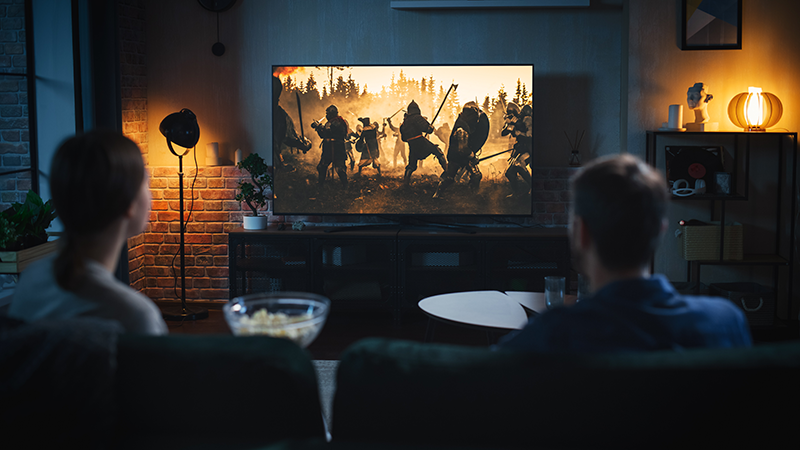
If there were a top 5 most frequently asked questions around home cinema and TV, this question is guaranteed to be among them: how big should my screen be?
A quick Google session yields a lot of answers, but they are often unreliable and contradictory, and they usually don’t tell the full story either. We need to do better than that…
The wrong question
In itself, it is a very logical question: you are planning to buy a new TV – or you want to (have) a projection system installed -, and you want your screen to be big enough so that you are fully involved in the story. But then again, the screen should not be too big, because then the viewing experience becomes tiring and you start noticing individual pixels in the image. And so you wonder exactly how big the screen needs to be to meet those goals.
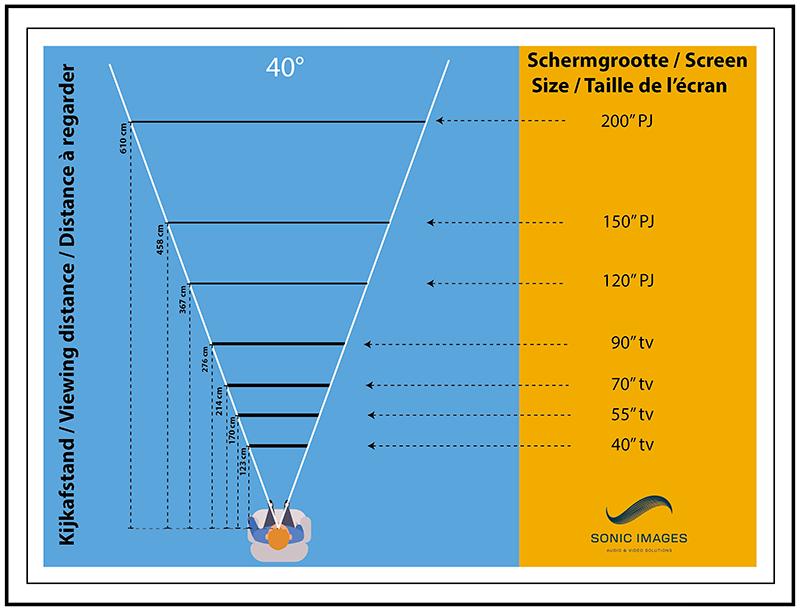
But actually, that is not the right question. That’s because a screen of a certain size – say a 65’ TV, with an image width of 145 cm – produces a very different viewing experience the closer or further away you sit from it. If you sit a metre away from such a 65’ screen, it is overwhelmingly large, but if you sit five metres away from it, on the contrary, it looks on the small side.
The optimal viewing angle
What you really want to know is what the optimal viewing angle is. In other words: how large a part of your field of vision (the horizontal angle) should be filled with images. Once you know that, and have decided at what distance you will sit from your screen, you can finally determine how big the screen should be.
The optimal viewing angle, in other words. But how do you determine that? On the one hand, there are technical factors that play a role in this, and on the other, there is also an objective element to consider.
The starting point
As mentioned, the idea is that you should be able to clearly see all the details in the footage, but not get so close that you see individual pixels and/or the viewing experience becomes unpleasant or uncomfortable. Leading institutes like THX and SMPTE (Society for Motion Picture & Television Engineers) have done the necessary research on this.
THX states that 26° is the ‘farthest acceptable’ angle, and 36° the ‘farthest recommended’ angle. SMPTE believes that an angle of 33.3° is the ‘farthest’. It is important to note that these recommendations are minimums for commercial cinemas, and they are also not very recent.
Acceptable versus high-quality
A commercial cinema is a substantially different thing from a home cinema, as a commercial cinema needs to allow many more people to watch films at the same time. Image and sound must therefore be provided in such a way that all visitors can enjoy at least an acceptable film experience.
But in a home cinema, ‘acceptable’ is not good enough. There, instead, you want to achieve the highest quality picture and sound reproduction for a small number of people. Just to say that a viewing angle of 26° might still be acceptable for a commercial cinema (for the back rows, that is), but not for home cinema or at home in front of the TV.
SMPTE also further states that an angle of 43.4° is the SMPTE reference, and that 61.8° is the closest angle. The interim conclusion from all this is that a viewing angle of <26° is too small, and on the other hand, the viewing angle should not exceed 62°. So the optimal viewing angle is somewhere in the area between those two extremes, but where exactly?
Resolution
There is a direct correlation between the recommended viewing angle and the resolution of the image: the higher the resolution, the closer you can sit to the image without seeing individual pixels. In other words, you can sit closer to a 4K TV than to a high definition (1080p) TV of the same size, because the pixels of a 4K TV (or projector) are smaller.
In reality, though, the story is a little more complex. In a 4K TV there is a scaler – a piece of electronics that converts all incoming image signals to 4K resolution (unless they already have a 4K resolution at the source) -, and so on a 4K TV (or projector) you will often be looking at images that actually have an original resolution significantly lower than 4K. By the way, 8K and high definition TVs and projectors also include a scaler.
In any case, it is recommended to choose a TV or projector with a sufficiently high resolution, as otherwise you may have to skimp on the maximum viewing angle.
The recommended viewing angle for HD
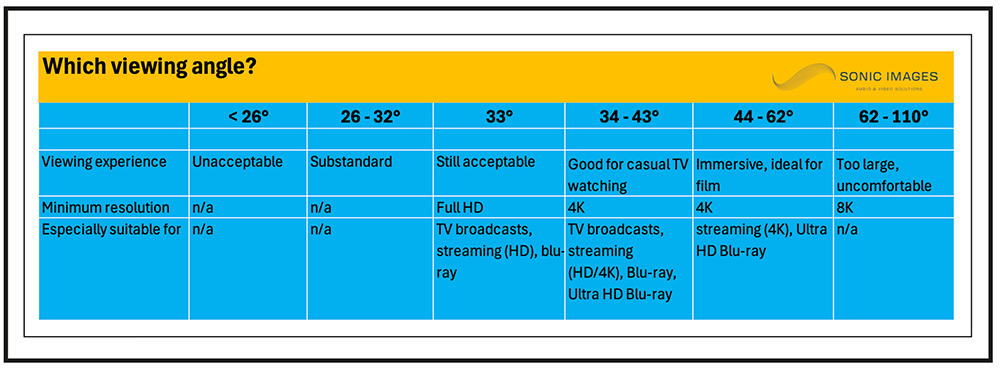
If the resolution of your TV or projector is limited to Full HD – 1920 x 1080 pixels – it is best to maintain a viewing angle of 33°. This is because if you were to choose a larger viewing angle, you will start to notice the individual pixels. Note that a viewing angle of 33° is towards the minimum of what THX and SMPTE recommend. In other words, if the resolution of your screen does not exceed 1920 x 1080 pixels, the viewing angle cannot be made large enough to be optimally involved in the story on screen. And yes, this is indeed a prime reason to replace your Full HD projector or TV with one with a higher resolution….
The recommended viewing angle for 4K
If you have access to a 4K projector or TV – i.e. with a resolution of 3840 x 2160 pixels – you can maintain a viewing angle of as much as 61° without starting to notice individual pixels. That number is almost equal to the maximum viewing angle SMPTE recommends for commercial cinemas and dubbing stages (61.8°). Consequently, the recommended viewing angle for 4K is between 62° and 44°. Further on, we explain which angle is best to choose finaly.
The recommended viewing angle for 8K
8K TVs and projectors allow viewing angles of up to 110° (!), before you can see any pixels. Technically, that’s impressive but in practice it’s not much use to you. A viewing angle greater than 62° is considered unpleasant by the majority of viewers. As the viewing angle rises towards 70° and more, you have to move your eyes and head back and forth too much – as if you were sitting with your nose on top of a tennis match – to see all the important elements in the picture. And so the recommended viewing angle for 8K is identical to that for 4K screens: between 62° and 44°.
Subjective factors
The first groups of people who enter a – then still – empty cinema hall, and who are thus free to choose any seat, usually do not all sit in the same row. There may be several reasons for this, but often it is also because some people want to sit closer to the cinema screen than others. A matter of personal preference, then. At home, in the home cinema or just in front of the TV, it is no different. And so – if you have a 4K/8K TV or projector – you have to decide which viewing angle works best for you personally.
And the winner is…
If you have a dedicated home cinema room with 4K or 8K images, we recommend going for a 60° viewing angle. You are then very much involved in the story, while the image on the other side is just not too big. Anyway, you don’t get to see individual pixels either. If you play a lot of video games in your home cinema, it is probably better to reduce the viewing angle slightly, to say 54°.
In the living room (with 4K or 8K image), you usually watch very diverse types of content – not only films but also series, the news, … – and then a viewing angle of around 46° is ideal.
In Sonic Images’ reference showroom cinema, we opted for a viewing angle of 60° (for 4K films in formats from 2.35:1 to 2.40:1) and for 48° (for 4K films in 16:9 format). We can choose between two viewing angles because we have a projection screen with masking, where part of the screen can be covered by black cloths that slide electrically into place.
Auteur: Thomas Van den Bossche, Audio & Home Theater Architect @ Sonic Images