Built-in speakers: variants and alternatives
In this follow-up article – the previous article can be found here – we look at a number of special built-in speaker variants, such as plasterable speakers and in-wall subwoofers. We also discuss some interesting alternatives, such as on-wall speakers and Cinewall systems.
Plasterable speakers
A plasterable built-in speaker, just like a regular built-in speaker, is incorporated into the ceiling or wall. What makes this type of speaker special is that you can plaster over it afterwards. This makes the speaker completely invisible. In other words, there is no way of seeing that there is a speaker behind the plasterwork. It seems like a kind of Holy Grail, and many (interior) architects are therefore particularly keen on it.
Unfortunately, plasterable built-in speakers have quite a few disadvantages. To begin with, they are much more expensive than regular built-in speakers. They sound good enough for casual listening, but if you really want to enjoy music seriously, they are not the best choice. Finally, the plasterwork covering the speakers can sometimes start to crack over time. And, of course, you can’t just have the speaker repaired or replaced if there is a technical problem: you have to break open the plasterwork, with all the consequences that entails…
Subwoofers
There are in-wall subwoofers, which you install in the same way as regular built-in speakers. An in-wall subwoofer supplements the limited low range of your built-in speakers with the necessary low tones. It is important to note that almost all built-in speakers fall short in this area. This is the main reason why a built-in speaker often sounds less good than a separate speaker cabinet.
There is also another method of integrating a subwoofer with built-in speakers. This involves concealing the entire speaker cabinet in an adjacent room, a false ceiling or a basement. A flexible tube is then used to carry the sound from the subwoofer to the room where you want to listen. All you see is a small grille in the wall or ceiling, where the flexible tube enters the room.

Finally, there are also subwoofers with a distinctly elongated design. These can be up to 150 cm or higher, but they are not much deeper than 10 cm and their width is limited to around 35 cm. Thanks to this shape, they can be fitted between the metal studs of a plasterboard wall. In our part of the world, we mainly build with brick walls, but in the US, for example, this approach with narrow subs is very popular. And not only to give built-in speakers the necessary support in the low frequencies, but also to integrate subwoofers into a home cinema room.
On-wall speakers
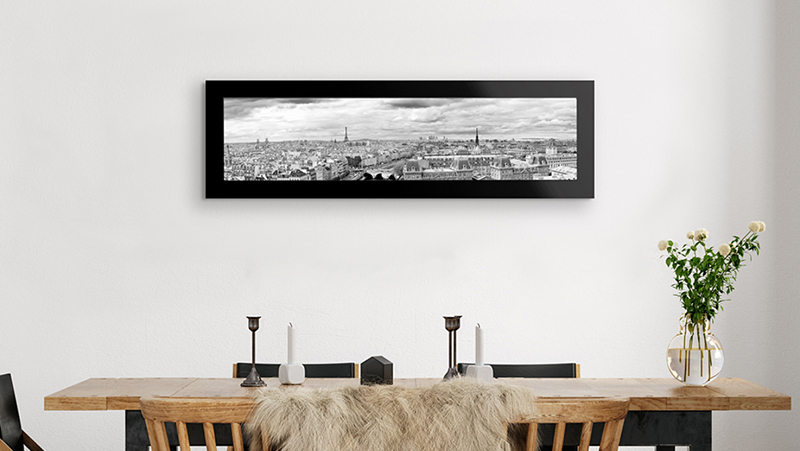
On-wall speakers are designed to be hung on the wall. That is why they are usually very shallow, often making them look like oversized photo frames. Due to the modest cabinet volume, the low range of such speakers is rather limited, but this can be solved by combining them with a subwoofer.
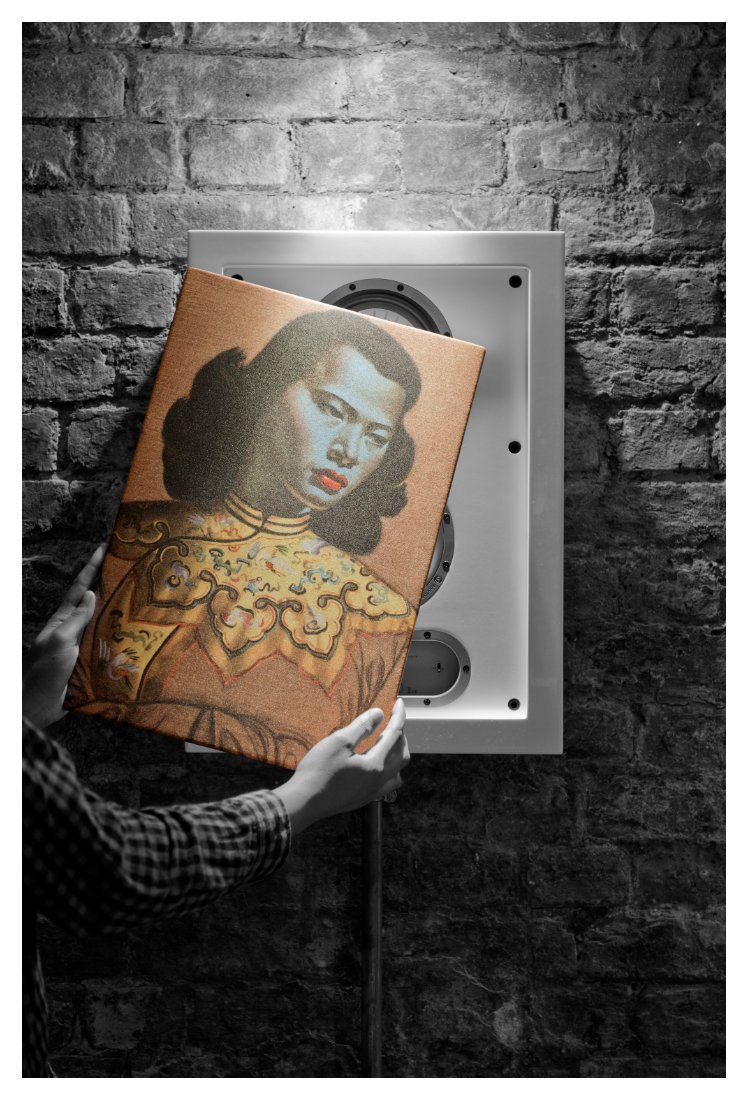
On-wall speakers are an attractive solution in themselves, but you still have to hide the speaker cabling, just as you would with built-in speakers. Otherwise, you are left with the unsightly effect of a photo frame with a cable attached to it. Incidentally, some manufacturers also offer the option of applying artwork to the speaker fabric on the front, so that the speaker is no longer recognisable as such.
Cinewall
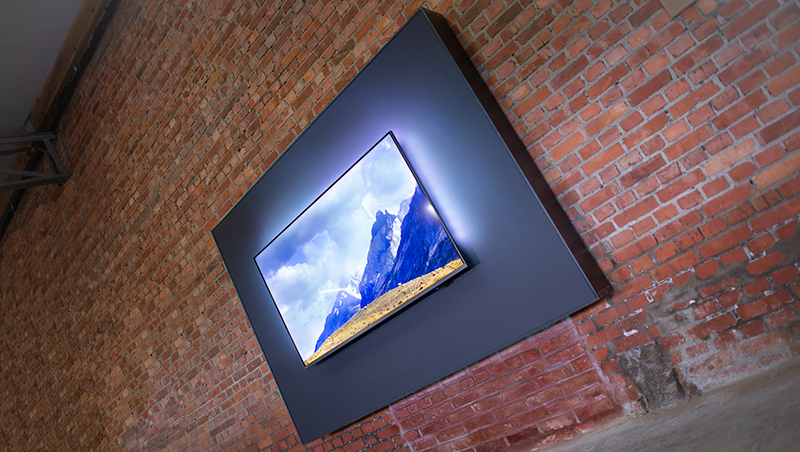
A Cinewall is an elegant frame that is mounted on the wall. In the centre of the frame, there is space to mount your television. Around it – completely concealed behind acoustically transparent fabric – the speakers are installed. A Cinewall not only has space for stereo (left/right) speakers, but also for a centre speaker and even one or more subwoofers.
So even if you want to integrate a complete surround sound system into your living room, you can conceal most of the speakers completely in the Cinewall. Depending on the speakers installed in the Cinewall, the sound quality can be exceptionally good.
Read more about built-in speakers in this article.
Auteur: Thomas Van den Bossche, Audio & Home Theater Architect @ Sonic Images