Built-in speakers: a smart choice?
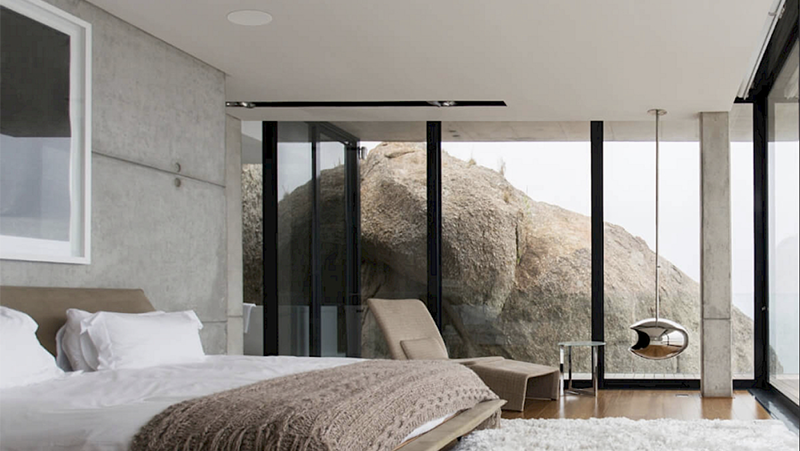
Built-in speakers are often preferred over traditional speakers – i.e. bookshelf speakers or floor-standing speakers – because they can be integrated into the interior in such an unobtrusive way. But are they as good as traditional speakers? And what should you look out for if you want to buy built-in speakers?
The range of built-in speakers on the market is particularly wide. They are available in all shapes, sizes and qualities, and therefore also with widely varying price tags. In this article, we explain which built-in speakers are most suitable for a number of specific applications. We also look at the best locations for installing them…
Serious listening or just casual (background) music?
First and foremost, you need to ask yourself what exactly you want the built-in speakers for: is it just to hear some music while you are in the bathroom or kitchen? Or do you want to use them in an environment – usually the living room – where you really want to be able to enjoy music and/or film sound? In the first case, you can opt for a more compact, cheaper built-in speaker, while in the second case, you will want a quality experience that is hardly, if at all, inferior to that of a traditional hi-fi speaker.
For this reason, it is not necessary to install the same built-in speakers throughout the home. On the contrary, it makes much more sense to work with two levels of quality: solid and relatively compact speakers in rooms where you listen to music casually, and higher-quality speakers, which may also be slightly larger, in rooms where you want to enjoy music or film sound to the fullest.
In the ceiling or in the walls?
When it comes to rooms where you don’t listen to music too critically, the ceiling is the most logical option. The speakers are less noticeable than when they are in the walls, and you also keep your walls free to do other things with them. But if you want to use the built-in speakers in a room where you really want to be able to listen to music (or film sound), it is strongly advised not to mount the speakers in the ceiling. If you do, it will be as if you are listening to a concert taking place on the ground floor from the basement. Quite unrealistic, in other words. The same applies when watching films or series: you see the actors in front of you on the screen, but their voices seem to come from the sky.
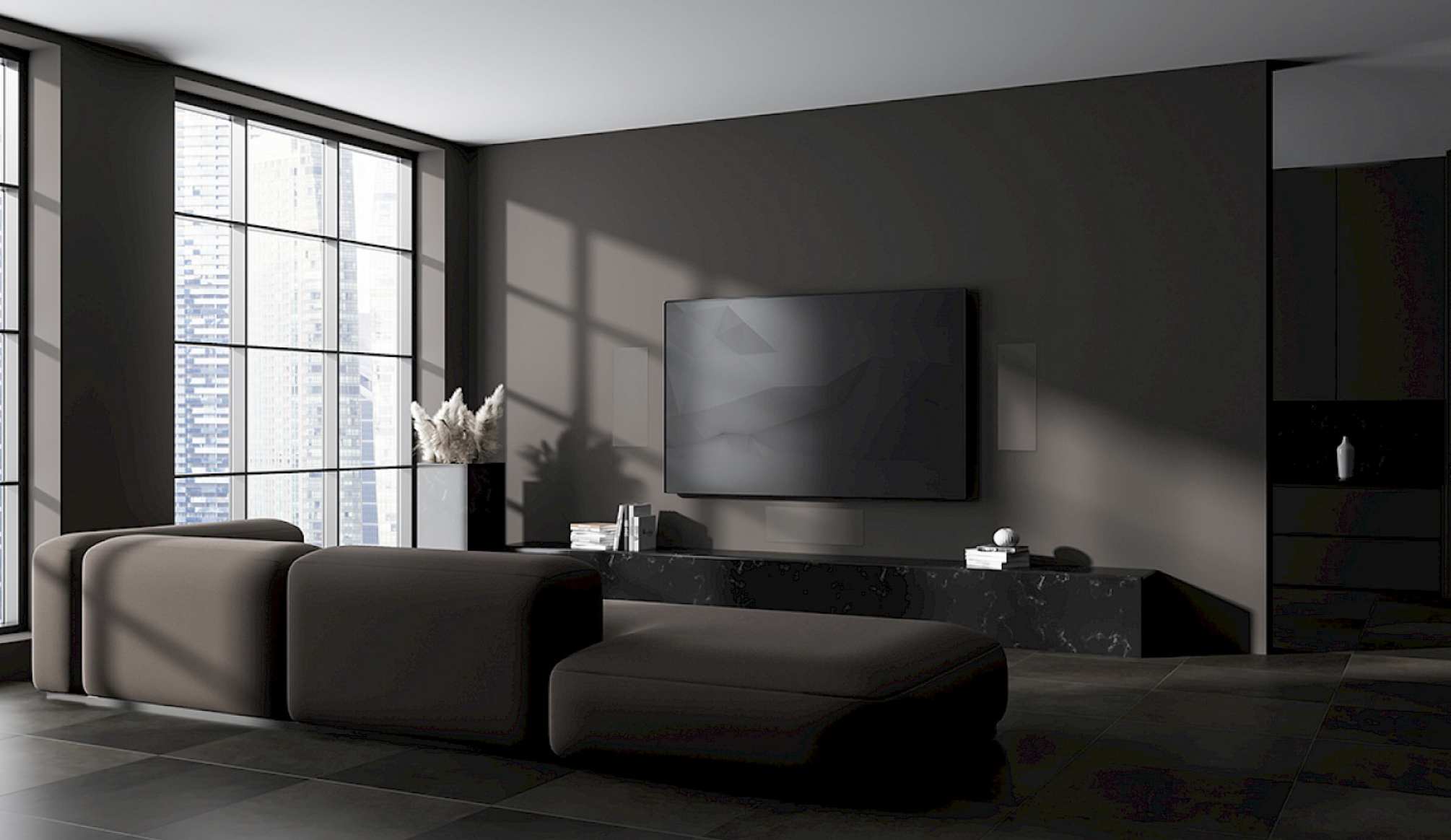
In other words, if you want to use built-in speakers to really listen to music, you need to install them in the walls. You should do this in such a way that the tweeter and midrange are approximately at ear level when you are sitting in your armchair. In practice, this is on average about 110 cm above the finished floor level.
Round, square or rectangular?
That is purely an aesthetic choice. The actual speaker drivers are round anyway (in 99% of cases), so whether they are housed in a rectangular, square or round enclosure makes no discernible difference to the sound quality. However, when multiple drivers are used in a built-in loudspeaker – such as a woofer, a midrange and a tweeter – the loudspeaker enclosure will often have a rectangular shape. This approach – with multiple independent speaker drivers in a single enclosure – is generally only found in the more expensive, high-quality built-in speakers.
From a practical point of view, a round built-in loudspeaker is slightly easier to install than a rectangular or square one. This is because a rectangular (or square) loudspeaker must be mounted perfectly straight and symmetrical – opposite the walls, windows, etc. Otherwise, the result looks rather clumsy. With round built-in speakers, this problem does not arise.
Size
We would have liked to tell you that a built-in speaker with a diameter of around 10 centimetres offers excellent sound reproduction, but unfortunately that is not the case. To achieve a reasonably balanced sound, you need a diameter of at least 20 centimetres. We are talking about relatively small spaces where you only want casual sound.
If you want to use built-in speakers to listen to music seriously, you will soon end up with a system that combines multiple drivers and is therefore less compact and usually has a rectangular form factor.
In addition, the installation depth is also important. Some built-in speakers only need 10 cm, but usually you need 15 to 20 cm of installation depth.
Construction
In an existing home, you will need to make holes in the walls or ceilings to install your speakers. If this is done during major renovations, it is not such a problem, because the home is already covered in dust anyway. Often, the same approach – making holes in walls or ceilings by chiselling them out or using a diamond drill – is used in new construction. There is nothing wrong with this, but in some cases there is a more elegant solution: some built-in speakers come with a separate built-in box, which is intended to be installed in the correct place during the structural work. The actual speaker can then be easily mounted in the box afterwards.
Of course, you also need to provide the necessary cabling. For a normal built-in loudspeaker, it is sufficient to install a 2-core loudspeaker cable, but for stereo built-in loudspeakers – see below – you need two loudspeaker cables (4 cores in total).
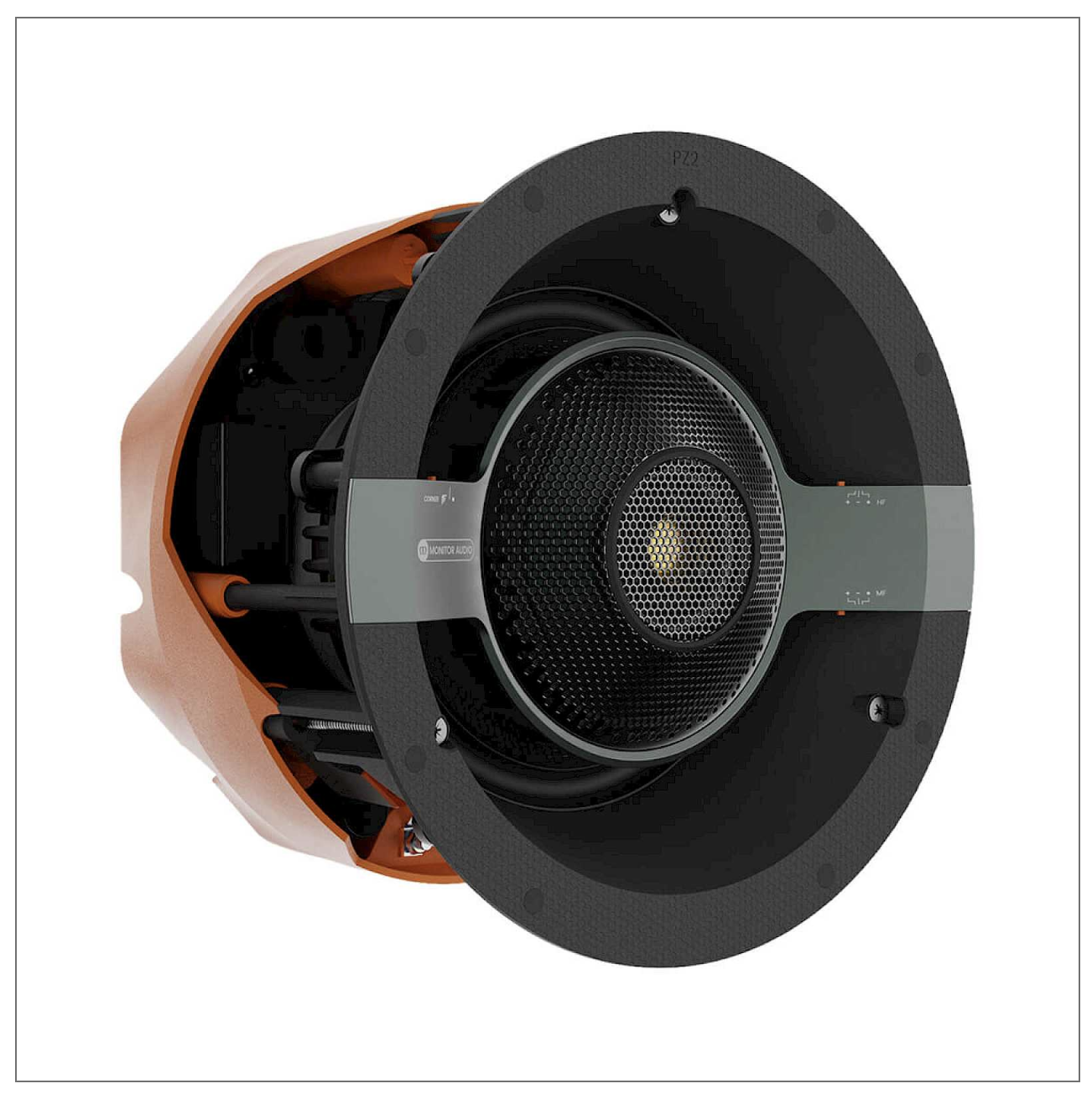
There are also built-in speakers that you can plaster over after they have been installed. Such a speaker is then completely invisible. It is impressive to experience this, but whether you want such speakers in your own home is another matter. Read more about it in this article.
Details
Many manufacturers offer built-in speakers that are suitable for flush mounting. This is a mounting technique whereby the front of the speaker – the visible side – is flush with the wall or ceiling. This makes them less conspicuous in the interior and gives the whole room a little more cachet.
In many cases, the speaker grille can be painted to match the rest of the ceiling, which further enhances the integration.
And if the room is too small to install two built-in speakers, you can opt for a stereo built-in speaker. Such a speaker looks like a normal built-in speaker, but actually combines two sound channels (left and right) in a single unit. This means that there is no stereo image, but if you just want background music in certain rooms, that’s not really a problem. It is often even better to configure a stereo pair as two mono channels.
Of course, it’s a completely different matter if you use built-in speakers for serious listening: in that case, you’ll need two speakers in a stereo configuration anyway.
Advantages and disadvantages
The biggest advantage of built-in speakers is that they can be integrated inconspicuously into the interior and do not take up any space. Moreover, they are generally cheaper than regular speakers, because the price of the housing is eliminated.
The biggest disadvantage is the lack of flexibility: once the speakers have been positioned, you cannot change them afterwards. When it comes to rooms where you just want good background sound – in the bathroom, for example – this rarely causes problems. But suppose you have decided where to place your sofa in the living room and have the built-in speakers installed in such a way that they form a correct stereo listening triangle in combination with the listening position in the sofa. If you then decide to move your sofa a metre to the left or right, or – worse still – if you decide to turn your sofa in a different direction, not much will remain of the carefully constructed stereo image. Unless you want to tear open the walls again to move the speakers, a scenario that is absolutely to be avoided.
More about built-in speakers in this follow-up article. There we discuss, among other things, plasterable built-in speakers, in-wall subwoofers, on-wall speakers, Cinewall systems, and so on.
Auteur: Thomas Van den Bossche, Audio & Home Theater Architect @ Sonic Images