10 smart solutions to keep your television out of sight
On average, a television is used for no more than four hours a day. This means that most of the time, it is simply a large black rectangle in your interior. In this article, we look at a number of solutions to remedy this problem…
1-Painting or photo
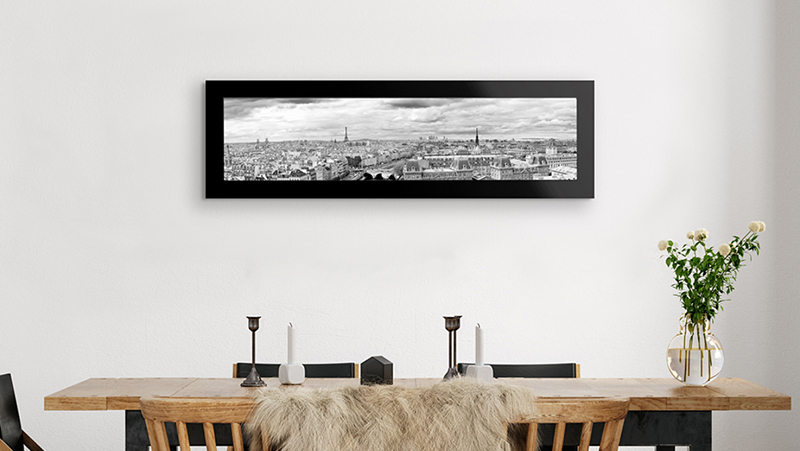
There are special frames – available in various styles – that you can hang your television in (which fit around your television). When you are not using the television, a hidden mechanism in the frame unrolls a cloth that conceals the television from view. The cloth can display a painting or photograph, and you can often supply your own artwork. This could be a family photograph, but it could just as easily be a beautiful landscape or an image of a painting you have created yourself.
2-Ceiling lift
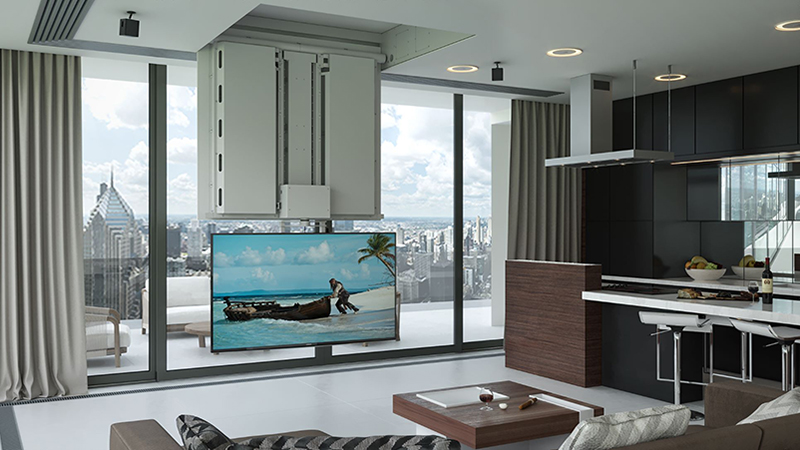
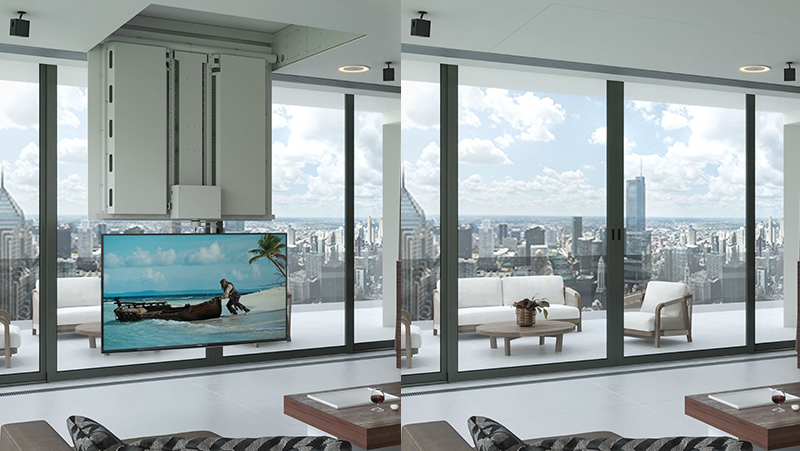
As the name suggests, a ceiling lift allows you to hide your television in the ceiling when it is not in use. When you activate the lift’s electric mechanism, the lift door – with the television attached to it – swings down 90°.
An additional mechanism is often provided, which lowers the television a little further so that the screen is at eye level. Finally, some models also allow the television to rotate – partially or completely – around its axis, so that you can direct the screen towards your viewing position.
In practice, ceiling lifts are not very common, largely due to their price tag: costs of around €10,000 are not unusual. In addition, such a system is large and heavy, so you need a sturdy ceiling to be able to install a ceiling lift.
3-Retractable TV bracket
Although this solution does not make your television disappear from view, a TV bracket allows you to use a smaller television (or two), while maintaining the same viewing angle as a larger model. This is because the viewing angle is influenced not only by the size of the television, but also by the viewing distance. And thanks to a pull-out TV bracket, you can significantly influence the viewing distance. In other words, if you bring the television closer, the image will appear larger. In this article, we explain the ideal image size and viewing angle to aim for.
The maximum range of a TV bracket is not much more than 100 cm, but that is usually more than enough for the purpose we have in mind here. In most cases, you can also rotate the television left/right around its axis, so you can turn the image towards you. A manually operated TV mount is very affordable, but an electric one can easily cost €1,000 or more.

4-Monorail
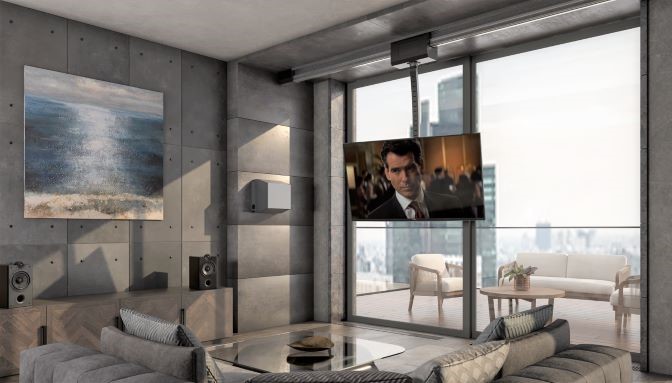
This unique system consists of a rail that is mounted to the ceiling, to which the television is suspended and can then be moved sideways. You can simply screw such a rail to the ceiling, but it is more elegant to do so in a recess in the ceiling, as is often done with curtain rails. Otherwise, you will have to be prepared to live with the somewhat industrial look that such a rail entails.
You can now move the television sideways along the rail – which can be as long as you want, as these are custom solutions – but if you want to use the rail to keep your television out of sight, you will need to provide a kind of “hiding place” along the rail behind which you can conceal the television. Of course, the television will hang a lot higher than desirable when viewed from the sofa.
5-Pop-up lift
A pop-up lift allows you to hide your television in a piece of furniture and then conjure it up when you need it. To achieve this in practice, you need a custom-made piece of furniture into which the lift can be built. The furniture must be at least as high as your television, plus about 20 centimetres for the lift mechanism.
The pop-up lift is one of the most interesting options in this overview in several respects. For example, the pop-up lift does not require a large investment and allows you to position your television at a comfortable viewing height.
6-In the cupboard
Long ago, when televisions still worked on the basis of a picture tube and were easily 70 cm deep – or more – such a television was sometimes tucked away in a cupboard. As soon as the set was switched on, the cupboard doors were opened. Simple and effective. With the advent of flat-screen televisions, this approach has fallen into oblivion, but in fact, it works just as well with a modern television.
In a modern interior, it is probably better to replace the traditional hinged doors with a single panel that can be slid up or down (or to the left or right). If the cabinet is against the wall – which will usually be the case – you can also combine this solution with a pull-out television stand.
7-Flat in the coffee table
You might think that you could also build a pop-up lift (see above) into your coffee table, but that’s not a good idea, because the coffee table would then be much too high. However, there is another solution, whereby the television is placed flat (with the screen facing the floor) in a lift that can then be built into a coffee table. When you want to watch television, the lift – with the television inside – swivels up 90° and you’re ready to go.
The coffee table will probably be close to the viewing position, which means that the television can easily be a size smaller. More about that in this article. In this setup, it is a challenge to get the necessary cabling – mains power, HDMI, etc. – to your coffee table in an elegant/invisible way.
8-Projection
A decent projection system, provided it is installed correctly, can evoke that real “cinema” feeling like no other, although you can also use it to watch television programmes and the like. You no longer need a television, but you do need to find a place for the projector. You also need a projection screen. There are variants that can be rolled up electrically, and you can even choose to conceal the screen housing (where the rolled-up screen disappears) in a recess or build it completely into the ceiling. The projector itself could be hidden from view in a slightly taller cabinet. Please note: as soon as you switch on the projector, it must be adequately cooled, so it should definitely not be placed in a closed cabinet. Unless you provide a specific cooling system for this purpose.
So there are a few issues to overcome if you want to replace your television with a projection system. Manufacturers are well aware of this, of course, which is why they have launched handy short-throw projection systems. Short-throw means that the projector’s lens is designed to allow the projector to be placed very close to the projection screen. Based on a short throw projector, you can have a piece of furniture made to measure – or buy one ready-made – with the projection screen emerging from one side of the furniture (which will usually be placed against the wall), while the other side has a kind of sliding mechanism that allows the projector to be removed from the furniture.
9-Under the bed
This solution is specifically designed for bedrooms. It is a sophisticated system in which the television is mounted flat on the floor (with the screen facing upwards) in a lift that is mounted on top of a rail. When you want to watch television, the television moves along the rail with the lift until it is completely behind the foot of your bed. The lift then swivels 90° forward so that you can see the screen while lying in bed. That is, after the lift has raised the television so that it is above the bed.
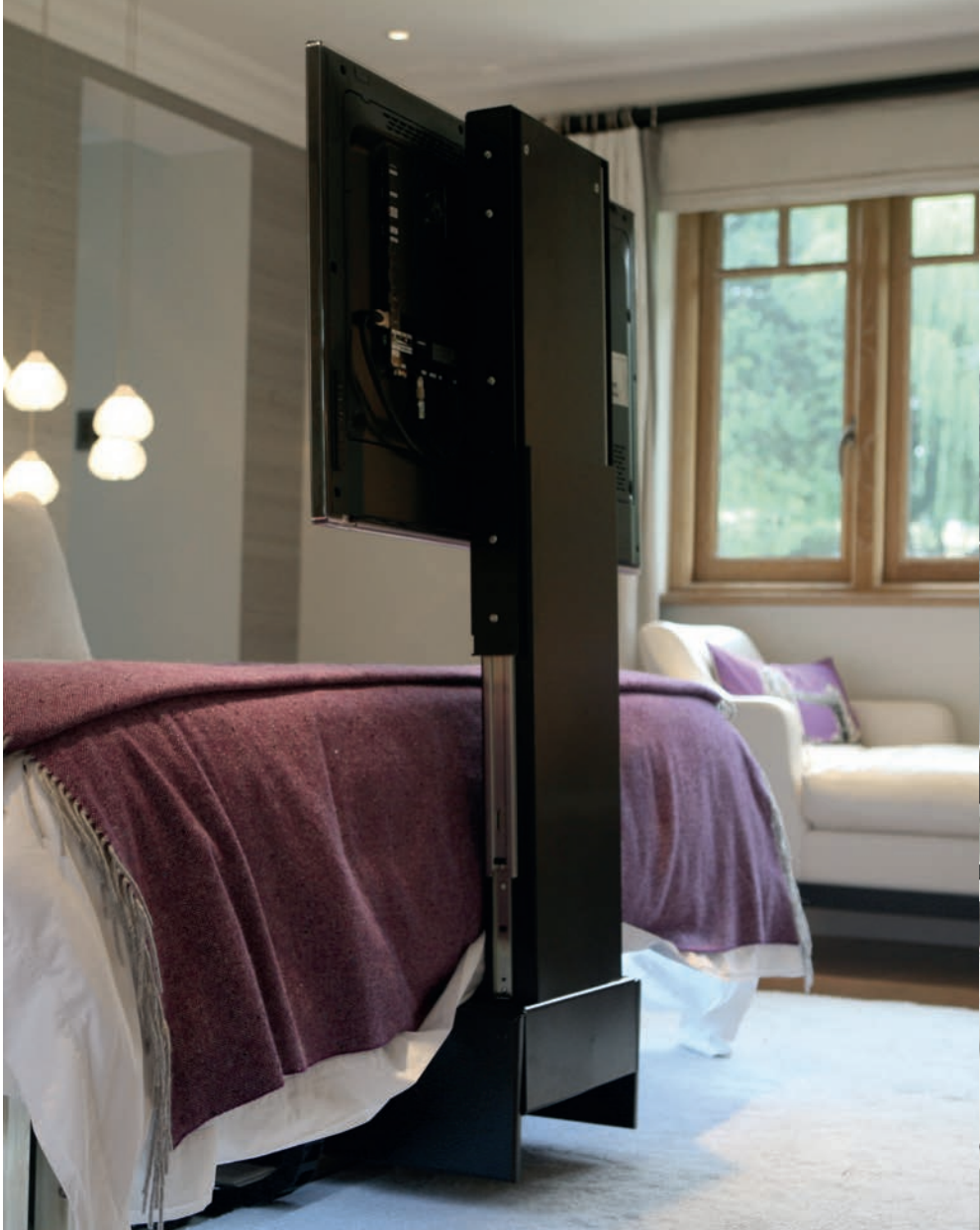
All this is quite complex and requires the rail to extend slightly beyond the foot of the bed. That is why, in practice, a pop-up system is usually chosen for the bedroom, whereby the television simply slides up from the foot of the bed.
10-Cinewall
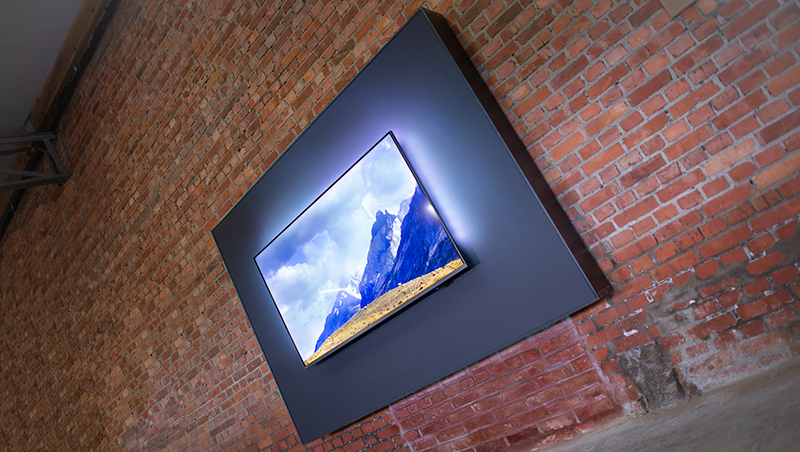
A Cinewall doesn’t so much make your television disappear as ensure that it is integrated into the living room in an elegant and aesthetic way. What’s more, you can also conceal an entire speaker system – and the associated cabling – from view in one go.
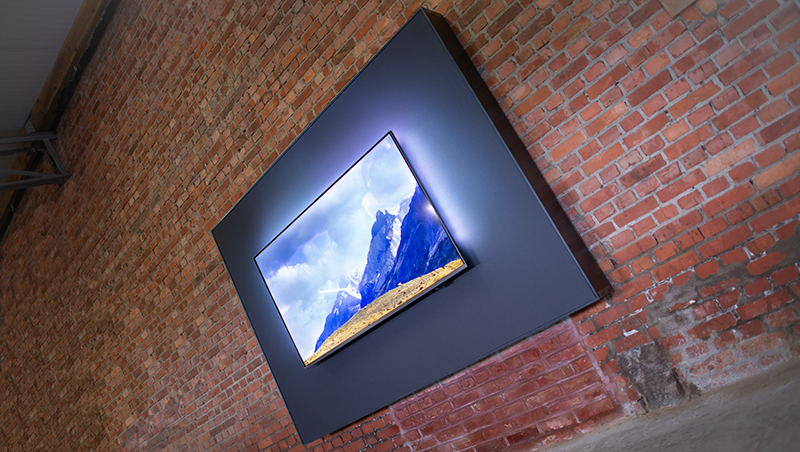
A Cinewall is a frame approximately 18 cm deep, covered with acoustically transparent fabric. As the fabric is available in dozens of colour options, it is easy to match the overall look and feel of your interior. The Cinewall also offers space for stereo speakers (left/right), as well as a centre speaker and even one or two subwoofers.
Auteur: Thomas Van den Bossche, Audio & Home Theater Architect @ Sonic Images